2017

Past

Caged Bird Soars at Book-It

Book-it Theater adapting I Know Why the Caged Bird Sings makes for the perfect marriage of form and content. The anecdotal nature of Maya Angelou’s memoir helps it become a perfect source for this troupe’s unique presentation of literary classics. Each separate scene of the autobiography builds upon the next until we have a complete dramatic portrait of a brave, rebellious and resilient black woman enduring and finally coming into her own.

Past

Seattle Shakespeare Company’s “Julius Caesar”

William Shakespeare’s Julius Caesar has captivated readers, audiences, and theater makers over four hundred years since its premier. Unfortunately, Seattle Shakespeare Company’s current production of the classic can barely hold its audience past intermission….
Seattle Shakespeare Company’s Julius Caesar is at its strongest when it leans into the present-day parallels. Craig B. Wollam’s set effectively brings to mind both the white-columned buildings of Rome and our nation’s capital. Doris Black’s costumes firmly anchor the production in present day Washington, D.C., from the power suits to an orange toupee. The physical world of the play helps the classic feel vital and relevant in 2017…

Past

Ayad Akhtar’s “The Who and the What” at ArtsWest

At ArtsWest Playhouse and Gallery, ArtsWest and Pratidhwani present The Who and the What, Pulitzer Prize-winner Ayad Akhtar’s play about a Muslim Pakistani-American writer whose controversial manuscript forces she and her family to confront issues of faith and identity. This well-written and well-produced play is funny, touching, and sure to prompt discussion about some contentious subjects.

The Who and the What kicks off ArtsWest’s 2017-2018 season, which is called “I Am,” and features plays that focus on struggles for identity. Ayad Akhtar’s follow-up to his 2013 Pulitzer Prize for Drama-winning Disgraced has no shortage of this type of conflict. The Who and the What is the story of Zarina, a writer struggling to complete her first novel, the daughter of immigrants from Pakistan, and a practicing Muslim. Zarina is finally inspired to finish her novel when she finds love with Eli, a white Muslim convert, ending months of writer’s block. However, the book’s depiction of the Prophet Mohammed and controversial take on women and gender politics in Islam causes conflict with Zarina’s family, especially her more conservative father and sister. They confront issues of religion, identity, and gender relations, as well as the conflicts within their own family.

Past

Grief Dialogues: The Play Debut

Elizabeth Coplan, Artistic Director of the Grief Dialogues project, has curated this set of six well-crafted 10 minute plays for this evenings play reading. All plays were directed by Wesley Fruge. Interspersed among the plays were poems by Jennifer Coates, Kristin Bryant, and Terry Severhill. A post show song, “Move On,” performed by Carla Rose Fisher accompanied on guitar by her husband Thomas Fisher, followed by Q & A with the audience rounded out the evening.

The value of workshop productions to writers. A new play grows into its final status

Past

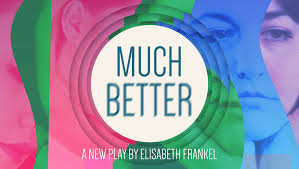
The trouble with an emotional life in the new play Much Better

We all have some parts of our personality that we would like to improve upon or possibly even change. Much Better, set in the future takes this human desire for self-improvement to another level. Unlike in our current times where personality alteration is achieved via drug regimes, Frankel’s play explores the possibility of more permanently altering one’s personality via brain changes. The brain changing treatment is called Neuroclear. Like the name suggests, the treatment doesn’t just mask any undesirable personality traits, the treatment erases them. As Dr. Keith explains to the main character Ashley, the treatment is like “plastic surgery for the personality.”

Scroll to Top